Waiting for the Barbarians

July 20, 2022
This morning, thanks to an article by former British diplomat Alastair Crooke, I discovered the early 20th century poet C. P. Cavafy who wrote this magnificent poem:
What are we waiting for, assembled in the forum?
The barbarians are due here today.
Why isn’t anything going on in the senate?
Why are the senators sitting there without legislating?
Because the barbarians are coming today.
What’s the point of senators making laws now?
Once the barbarians are here, they’ll do the legislating.
Why did our emperor get up so early,
and why is he sitting enthroned at the city’s main gate,
in state, wearing the crown?
Because the barbarians are coming today
and the emperor’s waiting to receive their leader.
He’s even got a scroll to give him,
loaded with titles, with imposing names.
Why have our two consuls and praetors come out today
wearing their embroidered, their scarlet togas?
Why have they put on bracelets with so many amethysts,
rings sparkling with magnificent emeralds?
Why are they carrying elegant canes
beautifully worked in silver and gold?
Because the barbarians are coming today
and things like that dazzle the barbarians.
Why don’t our distinguished orators turn up as usual
to make their speeches, say what they have to say?
Because the barbarians are coming today
and they’re bored by rhetoric and public speaking.
Why this sudden bewilderment, this confusion?
(How serious people’s faces have become.)
Why are the streets and squares emptying so rapidly,
everyone going home lost in thought?
Because night has fallen and the barbarians haven't come.
And some of our men just in from the border say
there are no barbarians any longer.
Now what’s going to happen to us without barbarians?
Those people were a kind of solution.
C. P. Cavafy, "Waiting for the Barbarians" fromC.P. Cavafy: Collected Poems. Translated by Edmund Keeley and Philip Sherrard. Translation Copyright © 1975, 1992 by Edmund Keeley and Philip Sherrard. Reproduced with permission of Princeton University Press.
Source:C.P. Cavafy: Collected Poems(Princeton University Press, 1975)
Cavafy was a Greek-born, partially Liverpool-raised, openly homosexual man whose experience of the world gave him what one biographer has called "a singular vision, one which explores, in various ways, the gratifications, and ramifications, of the pursuit of pleasure."
Yes. That's what his political-historical poem is about: at the level of national culture, therefore national policy, the fall of Rome - or the fall of Greece, or even the fall of the contemporary U.S. and EU - is the product and consequence of the pursuit of pleasure above responsibility. What we otherwise call decadence.
In his own essay, Crooke writes about this decadence not in terms of its excesses but in terms of its inevitably becoming a blind alley:
Though rational, the argument for an off-ramp misses the bigger geopolitical point: The West is so heavily invested in its fantastical narrative of imminent Russian collapse and humiliation that it finds itself ‘stuck fast’. It cannot move forward for fear that NATO might not be up to the task of confronting Russian forces (Putin has made the point that Russia had not even begun to use its full force). And yet, to cut a deal, to move back, would be to lose face.
And ‘losing face’ roughly translates to the liberal west losing.
The West thus has made itself hostage to its unrestrained triumphalism, posing as info-war. It chose this unrestrained jingoism. Biden advisers however, reading the runes of the war – of relentless Russian gains – have begun to scent another foreign policy débacle fast heading their way.
They see events, far from reaffirming the ‘rules-based Order’, rather the stark laying bare before the world of the limits to U.S. power – giving front of stage to not just a resurgent Russia, but one carrying a revolutionary message for the rest of the world (albeit a fact to which the West has yet to awaken).
Moreover, the western alliance is disintegrating as war fatigue settles in and as European economies stare at recession. The contemporary instinctive inclination to decide first, and think later (European sanctions), has landed Europe in existential crisis.
The UK exemplifies the wider European conundrum: The UK political class, frightened and in disarray, first ‘determined’ to knife its’ leader, only to realise afterward, that they had no successor to hand with gravitas to manage the new normal, and no idea how to escape the trap in which it is ensnared.
(Source)
This description put me in mind of my father-in-law's account of finally coming to terms with his need to put down JoJo, his beloved, aged Border Collie. He had to face facts when one day, after a multi-hour search for the poor beast, he finally found her across the road in the small stream. She had wandered in where the bank is shallow, then followed the easy way downstream as the banks became ever steeper until, finally, she was brought to a stop where a road crosses over, blocking the way forward except for a small culvert. There poor JoJo simply stopped; she hadn't the mental resource any longer to work out a solution to her problem, and so she stood there, dully facing the obstacle, her legs and feet in the icy stream, increasingly cold until she was shivering when my heart-broken father-in-law finally found her.
I look at Joe Biden and I see the same predicament. I look across the collective West and see nothing promising.
I look at the collective loss of brainpower, the senescence, and I think: we need Russia, and China, and Iran, and India, and all of the Second and Third Worlds in whom there is still vitality - who don't seek to freeze this moment in history, as do Klaus Schwab and his bosses and their willing acolytes (aged mentally beyond their physical years); nations whose people and leaders still believe in taking risks, in embracing an unknown and uncertain future like small boys who don't understand the risks they face when they see an exciting challenge --
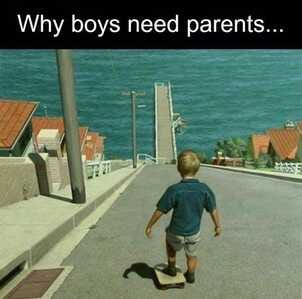
Those countries and their still-undeveloped potential, their unrealized opportunities, they are the barbarians. Thank God Cavafy was wrong! There are still barbarians, and if God is graceful to us there will always be. They refresh us. Without them the human race would simply run down and die of lethargy, fatigue, the boredom of too many decisions made without an ability to look up and notice the rut we have gently entered and then dug ever more deeply until we cannot see a way out; cannot find a new horizon worth exploring.
The day after my father-in-law found JoJo he did the merciful: he took her to the vet and had her put out of her misery. But he was never after the same, for he was already aged himself and was becoming stuck in his time (as I am becoming in mine), and even though he eventually picked out another dog after Ms. Gothic and I moved in with him and his wife, Dozer was never his dog, and so imprinted on me instead.
He kept JoJo's ashes and hoped to be buried with her. When he died we got unofficial permission to honor his wish - in small towns such humane and respectful permissions can still be granted among friends and neighbors despite written laws and official health regulations. But it is a sign of our cultural senescence that we cannot officially recognize such simple dignities because, I think, to do so wreaks decay and death, the very things we are trying to prevent as a hegemonic Power now past our prime.
And this reminds me of the first funeral I conducted at a particular establishment. I arrived a half hour early to discover the Home had placed the casket and body down one side of an L-shaped room, and the mourners' chairs down the other. I was to stand at the juncture. When I asked why the set-up, the director told me it was to spare the mourners from having to see the casket. I ordered a rearrangement: if we do not see death, if we do not look at reality, how can we address our own mortality? How can we find the humility we all must have to truly love life and value our family and friends?
We have already stolen from out of the hands of loving family members the honest task of cleaning up our dead's corpses and anointing their bodies with sweet smelling herbs while we wash them with our tears and keen our deep loss. How much more sanitary must we make our lives? How many other ways shall we mask ourselves from all evidence that we are, in fact, merely mortal, destined to just a few years of earthly life? How shall we know how precious it is to live, and how horrible it is to deal death, if we deny our gross mortality?
Next up: the twin evils of endless wars that waste other peoples' lives, and the Schwabian desire to merge our elite selves into machinery, and so to never be extinguished; to live forever frozen in a moment of time, supremely bored and, therefore, supremely autocratic and debauched, in ever-greater need of a barbarian to break in and destroy the wires and plumbing that keep our brains pulsating.
A month ago, Niccolo Soldo wrote a post he titled, "Delusion." It opens with these words:
A common thread in postwar histories of WW2 was one that liked to paint Adolf Hitler as increasingly unhinged and detached from reality towards the end of the Third Reich. We were told stories of how he liked to indulge himself in flights of fancy, surveying architectural models of a new Berlin, one that was to be built after Germany won the war, despite the Allies already closing in on both sides. Delusions of future grandeur, while everything was collapsing all around him. A case of “cope”?
The feel of omnipotence after a string of great successes can often lead one to think of themselves as permanent victors, incapable of defeat. This enters the realm of delusion when the facts on the ground run counter to the perception of victory. This is the real estate currently occupied by a large segment of the US foreign policy community.
(Link)
That's so self-evident as to not need saying. And yet, it needs to be said because it is not self-evident to the very people to whom it should be the most evident. Soldo's article includes a map of how Russia is meant to be carved up and shared out among the victorious western nations whose sun will never set.
They are leading us down the river, up the blind alley. They don't know which way to turn or what way to go.
The point here is that the West is comprehensively stuck: It cannot move forward, nor back. Its structures of politics and of the economy prevent it. Biden is stuck on Ukraine; Europe is stuck on Ukraine and on its belligerence towards Putin; ditto for the UK; and the West is stuck on its relations with Russia and China. More importantly, none of them can address the insistent demands from Russia and China for a restructuring of the global security architecture.
If they cannot move on this security plane – for fear of losing face – they will be unable to assimilate (or hear – given the ingrained cynicism that attends any words spoken by President Putin) that Russia’s agenda goes far beyond security architecture.
For example, the veteran Indian diplomat and commentator, MK Badrakhumar writes:
“After Sakhalin-2, [on an Island in the Russian Far East] Moscow also plans to nationalise Sakhalin-1 oil and gas development project by ousting U.S. and Japanese shareholders. The capacity of Sakhalin-1 is quite impressive. There was a time before OPEC+ set limits on production levels, when Russia extracted as much as 400,000 barrels per day, but the recent production level has been about 220,000 barrels per day.
The overall trend of nationalising the holdings of American, British, Japanese and European capital in Russia’s strategic sectors of economy is crystallising as the new policy. The cleansing of the Russian economy, freed of Western capital, is expected to accelerate in the period ahead.
Moscow was well aware of the predatory character of Western capital in Russia’s oil sector — a legacy of the Boris Yeltsin era — but had to live with the exploitation as it didn’t want to antagonise other potential western investors. But that is history now. The souring of relations with the West to almost breaking point rids Moscow of such archaic inhibitions.
After coming to power in 1999, President Vladimir Putin set about the mammoth task of cleaning up the Augean stables of Russia’s foreign collaboration in the oil sector. The “decolonisation” process was excruciatingly difficult, but Putin pulled it through”.
(Crooke's essay)
"Putin pulled it through." That is the general approbation of the world outside of NATO and its closely associated countries. All it takes is reading outside of the West-captured press to realize that two-thirds of the world is saying, "he did it; Putin pulled it off, thank God."
The barbarians are at the gates. They might have been delayed a bit as they checked their equipment and honed their weapons, but they are coming with the rising sun of this dawning new Day.
Will it be perfect? Far from it. But it will not be worse than the path we have set for ourselves, that has only a dead end to it. Literally, a dead end. Arguably it will be better, though different, requiring us to adapt our perceptions of the good life away from so much accumulation.
These barbarians, though, they offer something we've lost. By and large they have the effrontery to still believe in a living human soul, worth attending to and giving room to flower. They are setting in motion a new economic model free of the West's "capitalism or communism" bipolarity.
[T]oday we deal with shades of grey – there is no truly free market in the U.S.; and China and Russia are mixed economies, albeit ones leaning to prioritising a responsibility for the welfare of the community as a whole, rather than imagining that individuals left to their own selfish devices will somehow result in maximising national welfare.
Here is the point: Adam Smith economics plus individualism is ingrained in the western zeitgeist. It will not change. However, President Putin’s new policy of cleansing the Augean Stables of ‘predatory western capital’ and the example set by Russia of its metamophose toward a largely self-supporting economy, immune to dollar hegemony, is music to the ears of the Global South and to much of the Rest of the World.
(Crooke's essay)
The former Southeast Asian anthropologist James Scott wrote in The Art of Not Being Governed that those who left early valley-centered Chinese settlements for the surrounding highlands often exercised a principle that no one should acquire too much wealth. There is evidence to indicate that when some highlands villager became too wealthy and didn't share that wealth for the benefit of the entire community, the others would simply kill the hoarder and share out the goods.
That was an extreme version of the ethic Crooke has identified as the antithesis to the western pattern of "Making debtors dependent on wealthy creditors [in] what today’s economists call a ‘free market’." In the modern incarnation of the antithesis, "China is structured as a ‘low cost’ economy: cheap housing, subsidised education, medical care and transport – means that consumers do have some free disposable income left over – and China as whole, is made competitive."
Here in what we keep telling ourselves is the more civilized West, we peasants are busy oiling up our torches and sharpening our pitchforks. It appears that we are looking for a way to close the wealth inequality gap, and secure our dignity as human beings with rights to life, liberty, and a happy, satisfying life.
Maybe the distance between our hearts' desires and the Russian-Chinese proposal that is attracting the rest of the world is not all that large.